Showing posts with label FORTS. Show all posts

31 May 2022 - FORT STACHELBERG - TRUTNOV, CZECHIA


FORT STACHELBERG

 - TRUTNOV, CZECHIA -


G'day folks,

This fortress was designed to prevent a Nazi invasion but was never used.  

From 1935 to 1938, Czechia began building fortifications on its border with Nazi Germany. Most of these fortifications were located in the so-called Sudetenland, the mountainous region between Czechia and Germany which was mostly inhabited by ethnic Germans.


Of course, the Sudetenland was famously surrendered to Hitler in 1938 under the British policy of appeasement, meaning that these fortifications were never finished and ultimately never used. Nevertheless, the structures continue to stand as an open-air museum and an interesting hiking area, complete with a weekend Biergarten overlooking the Sudety low-mountain range.

Most of the interesting sites are in the core area of the fortress, a hilltop area open to the public. Although most of the smaller bunkers are free to visit, the largest contains a museum which is accessible for a small fee. Several smaller bunkers can also be found in the woods and hillsides, along with a popular hiking and biking path on the other side of the street.
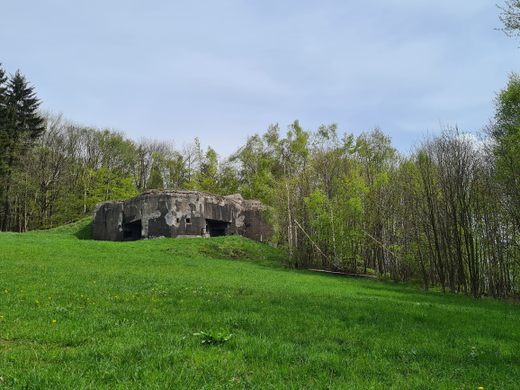
Clancy's comment: Countless precautions like these were built for protection. 

I'm ...


13 May - NEWHAVEN FORT - ENGLAND


NEWHAVEN FORT 

- ENGLAND -


G'day folks,

A Victorian Fort built into the chalky cliffs that overlook the English Channel. 

A site of defense since the Iron Age, Newhaven Fort has seen a lot of local history. It was fortified during the  1860s to prepare for an imminent invasion of the French. Its unique design comes from the fact that it was built into the contours of the land, instead of on top of it like a traditional fort or castle, which allows for numerous subterranean tunnels and chambers.


From its high vantage point over the English Channel, large guns were installed, and by the time the First World War broke out Newhaven Fort had become an integral part of protecting the South Coast of England, which played its part in sending six million tons of supplies across to France. During the Second World War the fort housed the thousands of soldiers who passed through the area. Its position to the harbor played a role in many key turning points of the conflict, including the D-Day landings of 1944.

After the World War II, Newhaven Fort fell into disrepair, and at one point in the 1960s it was nearly developed into a leisure complex. In 1979, it was declared an ancient monument and after a series of owners, it became the visitor attraction it is today. The fort is now full of interactive exhibitions, such as a blitz bomb shelter experience, and houses a vintage tearoom. Paranormal investigators regularly visit the fort to investigate the spooky goings on, particularly down in the caponiers, the huge tunnels built into the cliffs.

Clancy's comment: I'd love to check out the tunnels.

I'm ...


28 January 2022 - FORTRESS GORAZDA - MONTENEGRO


FORTRESS GORAZDA

 - MONTENEGRO -


G'day folks,

This World War I fortress is the perfect place to catch a Montenegrin sunset.  

This Austro-Hungarian fortress was used by the Austrians during World War I, as they traded artillery shells with Montenegrin forces. It was originally constructed around 1884-1886. Although the turret guns are long gone, the fortress and all its glory still remain.


 The fortress was later used as a prison during the mid-20th century. Now, it sits completely abandoned on top of a mountain overlooking both the bay of Kotor and Tivat. Although it’s now now covered in graffiti, it remains an amazing place to explore. It’s also an excellent spot to watch the sunset. The views are probably among the best in the entire region.


Clancy's comment: Worth a visit I would say.

I'm ...


23 January 2022 - FORT of SAN CRISTOBAL - Spain


FORT of SAN CRISTOBAL

 - SPAIN - 


G'day folks,

This huge abandoned fortress hidden inside a mountain holds a world of subterranean secrets. 

An enormous underground fortress hides within a Spanish mountaintop. Officially closed and abandoned by the military, its maze of silent corridors leads urban explorers, graffiti writers, and investigators of the paranormal alike deep into its world of subterranean secrets and horrors.

Originally viewed as a turn-of-the-century fortification in the early 1900s, the San Cristóbal Fortress was soon rendered obsolete with the emergence of airstrike operations. During the Spanish Civil War and Franco’s dictatorship, it was transformed into a prison that hosted thousands of men within its damp walls.


 During the fort’s stint as a prison, it became known for its harsh conditions. Summary executions, starvation, and tuberculosis were occurrences within the dank, depressing space. It wasn’t long before the mountain became filled with unnamed corpses, secretly buried in mass graves.

Not all captives were willing to accept their harsh fates. Beneath the light of a full moon in May of 1938, during the Spanish Civil War, 795 prisoners escaped from the fortress and fled into the night. Unfortunately, most were rearrested and once again faced deplorable conditions. More than 200 people died, hunted by guards and executed. Only three men managed to successfully escape to France.

The prison closed in 1945. A monument to those who escaped in search of freedom now stands atop the mountain.


Clancy's comment: Wow, only three managed to escape to France. 

I'm ...


27 January 2022 - THE GIGANTIC AMBOHIMANGA MAIN GATE


THE GIGANTIC 

AMBOHIMANGA 

MAIN GATE


G'day folks,

This giant disc-shaped gate took 20 men to close off this city in Madagascar. 

In the 18th century, Ambohimanga was a town that needed to protect its royal family. Shielded naturally by forests, the town also erected a massive wall, and seven outer gates to protect its people. The main entrance of these seven gates guarding the town from attackers was known as Ambatomitsangana, the standing stone, and it proudly still waits in position to be used for protection. 


The standing stone is exactly as it sounds, a massive stone disc weighing 12 tons. As with many walled cities of the Merina Kingdom in Madagascar at the time, the gates were created out of circular discs that were pushed into position by hordes of men every night. The stone disc guarding Ambohimanga took 20 men, and was over 130 feet in circumference. Each night, these guards would roll the stone into position, blocking off the main entrance to the town.

Today, the entire Ambohimanga area is a UNESCO World Heritage Site, and is home to royal burial grounds, the queen’s pavilions and the gigantic standing stone. 


Clancy's comment: Man, that is one whopping gate.

I'm ...


15 May 2019 - 19th CENTURY FORT BENEATH ALCATRAZ


19th CENTURY FORT
 BENEATH ALCATRAZ

G'day folks,

Before Capone took up residence, the island was home to military installation that guarded San Francisco Bay.

lcatraz Island in San Francisco Bay has a long history as a military and federal prison. But before the Rock became the Rock, the site was home to Fort Alcatraz, a military installation commissioned to protect the then-burgeoning city of San Francisco. That fort, and most signs of it, are long gone. But as Katie Dowd at SFGate.com reports, archaeologists recently located hidden structures below the concrete prison that show a glimpse of what was.


Because of its historical importance—Alcatraz Island is part of the Golden Gate National Recreation Area and administered by the National Park Service—archaeologists couldn’t just dig up the mostly cement prison yard to see what was under it. Instead, researchers used non-invasive ground-penetrating radar and laser scans to locate to see if they could find anything still lying beneath. Afterward, they compared their results to old maps, historical documents and photographs to help them interpret their data. All together, they believe they’ve located an ammunition magazine, a “bombproof” earthwork traverse as well as brick and masonry tunnels. The finds are revealed in the journal Near Surface Geophysics.


“This really changes the picture of things,” lead author Timothy de Smet, an archaeologist at Binghamton University, tells Katherine J. Wu at Nova. “These remains are so well preserved, and so close to the surface. They weren’t erased from the island—they’re right beneath your feet.”

There’s a reason the fort at Alcatraz didn’t last. Adam Brinklow at Curbed San Francisco reports that construction of a brick and masonry fort on the island began in 1853, but even before it was completed, powerful new artillery made that style of construction obsolete. In 1870, the military began a project to upgrade the island to sturdier earthwork fortifications, but that plan was not completed. Instead, during the Civil War and late 1800s, the military began using Alcatraz as a prison and quarantine zone for soldiers with tropical diseases. Its reputation as a prison fort grew from there, and in 1907, the U.S. officially designated it a military prison. 

The military went about constructing the massive concrete cellblock it’s become known for—the world’s largest reinforced concrete building at the time of its completion in 1912—burying the remains of the old fort and earthworks beneath.


Maintaining the island prison was a costly endeavor, not to mention Alcatraz’s harsh conditions were bad PR. In 1933, the military transferred the prison to the U.S. Bureau of Prisons where for the next 30 years it served as a segregation unit for the most difficult prisoners housed in federal custody. That’s the era that made the Rock legendary in popular culture. Due to the expenses of running it, it closed its doors for good in 1963.


The new archaeological research shines a light on the long-lost history of the island before Al Capone, Machine Gun Kelly and the “Birdman” Robert Stroud made it infamous. “This really reinforces what several historians and archaeologists had long suspected,” co-author and Alcatraz historian John Martini tells Wu. “Up until this point, we had nothing to go on except for a few visible trace remains and maps—and a lot of suspicion.”

In the article, the researchers suggest this type of non-invasive research can help archaeologists investigate other sensitive places, too, so as they put it they can “figuratively rather than literally dig up an otherwise inaccessible but fascinating past.”


Clancy's comment: Mm ... there ya go.

I'm ...