Showing posts with label ENGLAND. Show all posts

23 September 2022 - THE ANCIENT CAVES OF NOTTINGHAM, ENGLAND.


THE ANCIENT CAVES OF

 NOTTINGHAM, ENGLAND. 


G'day folks,

A labyrinthine underworld of tunnels and caverns hides beneath this city. 

Underneath the modern city of Nottingham is a large and ancient labyrinthine underworld. Over 800 caves, tunnels, and passages cut into the sandstone rock lurk beneath the city, and more are discovered every year.

The oldest recorded name for Nottingham is “Tigguo Cobauc,” which, in the pre-Roman ancient British language is thought to mean “Place of Caves.” The name is still appropriate today, as there are more caves underneath the city than any other in Britain. Nottingham sits on a ridge of soft sandstone hills, which in places have been cut into low cliff faces by the action of the River Leen and River Trent. The exposed soft crumbly rock is incredibly easy to cut and burrow into.


The caves were dug for many reasons: as workplaces, such as the medieval tannery that exists underneath a shopping mall; as homes, such as those at Sneinton hermitage; as secret passages and tunnels, such as those at Castle Rock; as storerooms, brewhouses, and public houses; as prisons and dungeons; and in more recent history, as air raid shelters during the Nottingham Blitz. Scattered across the city are small doors and gates, complete with rusty padlocks that cover access points into the greatly interconnected labyrinth.

The Nottingham Caves Survey, a project by researchers at Nottingham University to digitally map the caves, has seen many local homeowners come forward to reveal that they too have caves leading off into the subterranean maze from their basements or tucked away in the corner of their garden. Some have been surprised to learn that their particular cave was previously unknown. As recently as January 2017, a group of students living on one of the main roads into the city, Mansfield Road, discovered a series of steps leading down from their cellar into a previously unknown void under the city streets.

One of the most well-known and well-connected cave systems is the Broadmarsh Caves, which is open to visitors under the name “City of Caves.” This visitor attraction can be accessed from a dilapidated shopping mall, the Broadmarsh Centre, which is scheduled for demolition and redevelopment. In it, underneath the 1970s brutalist edifice, visitors can take a guided tour around the medieval tannery cut out of the sandstone, the remains of a medieval slum, and one of the city’s sandstone air-raid shelters.

Another system called Mortimer’s Hole is also open to the public, accessed from Brewhouse Yard. This cave is named after Sir Roger Mortimer, the lover of Queen Isabella of England in 1330. The enraged king is said to have entered the grounds of Nottingham Castle by stealth through this secret tunnel, from the base of the Castle Rock cliff, and seized poor Mortimer as he lay in bed with the queen. He was taken from Nottingham to London to be hung, drawn, and quartered. (Tales of his ghost still haunting the hole, which bears his name, remain unverified.)


Other great places to visit the caves include the Trip to Jerusalem public house, reputed to be England’s oldest pub, Victorian Music Hall Malt Cross, the Lost Caves cocktail bar, and the Hand and Heart, all of which have cave rooms for drinking and eating in, and the Bell Inn. If you inquire in advance, the Bell can arrange tours of its caves underneath the Old Market Square, including one that contains a well once used by local monks for brewing ale. Live action puzzle fans are accommodated in one of the city’s latest labyrinths to be made publicly accessible; the “Cave Escape” escape rooms can be found in gloomy subterranean chambers and tunnels beneath Mansfield Road.

19 August 2022 - TREEHOUSE RESTAURANT IN ENGLAND


TREEHOUSE 
RESTAURANT
 IN ENGLAND

G'day folks,

This giant wooden treehouse within a sprawling garden has its own eatery. 

The wondrous garden anchored by the Treehouse Restaurant was once part of the official residence of the Duke of Northumberland in the 11th century. Today, the land is known as the Alnwick Gardens, a bucolic setting featured in the early Harry Potter films. For the dendrophiles among us, the arborous building at the heart of these gardens is more likely something featured in your wildest dreams.


The 6,000-square-foot complex is a celebration of wood: pine, cedar, and redwood, all carefully intertwined to make a theater of natural elements suspended in the tree-line of the ancient forest. Growing trees literally spew forth from the floors while in the wintertime, a cozy fireplace lazily crackles. Need you guess what the tables and chairs are made from?

The menu boasts Northern English fare with an emphasis on seasonality and locality. While the menu reads beautifully, some diners note that execution can be spotty. Perhaps a warm drink by the fire would do a winter soul enough good.


For its design alone, the restaurant is well worth a trip from nearby Newcastle. You’ll surely work up an appetite gushing over all the wood.

1 July 2022 - EDITH CAVELL - ENGLAND'S HEROINE NURSE


EDITH CAVELL

- ENGLAND'S HEROINE NURSE -


G'day folks,

Every year, two chosen nurses lay a wreath on the statue of Edith Cavell near Trafalgar Square in central London. Meanwhile, some 200 miles north-east of the capital, a memorial service is held in the church at the rural village of Swardestone, where she was born.

Cavell was a nurse working in occupied Belgium during the First World War and was executed by a German firing squad on this day for gradually helping about 200 British and French soldiers to escape the country. She was aged 49.

Her death caused shock and outrage across the world and played a significant part in bringing a disgusted USA into the war.

Cavell, born in 1865, became fluent in the French language which she learnt at school, enabling her to work as a governess for families across Europe, including Brussels.

But after taking care of her sick father she decided to become a nurse and enrolled at the Royal London Hospital. There, Royal Family surgeon Antoine Depage persuaded her to return to Brussels and run a training school for nurses at the Berkendael Medical Institute.

After Germany invaded Belgium in 1914 Cavell’s clinic and nursing school was turned into a Red Cross hospital. She treated wounded soldiers wherever they came from and with her strong religious beliefs is said to have declared: “I can’t stop while there are lives to be saved.”

However, she became involved in an underground group formed to help British, French, and Belgian soldiers reach neutral Holland. They were sheltered at the hospital then given money and guides.

But the suspicious German secret police had been keeping an eye on the hospital and in August 1915, they arrested Cavell and charged her with treason for helping at least 200 soldiers to escape. “Had I not helped,” she said later, “they would have been shot.”

She was kept in solitary confinement for 10 weeks, then at her trial pleaded guilty to the charges against her. She was sentenced to death by firing squad.

Diplomats from the neutral governments of the United States and Spain protested but their efforts were in vain. The night before her execution, Cavell told the Rev. Horace Graham, a chaplain from the American Legation: “They have all been very kind to me here. But this I would say, standing as I do in view of God and eternity: I realise that patriotism is not enough. I must have no hatred or bitterness towards anyone.”

After the war, her body was taken to London’s Westminster Abbey for a state funeral before being buried at Norwich Cathedral near her home town.


Cavell’s execution led to a strong rise in anti-German feeling in the United States as well as in Britain, where she was idealised as a heroic martyr.

The Germans claimed that Cavell was not just rescuing Allied soldiers, but was also a spy smuggling intelligence back to Britain. Ironically, in 2015, the British Secret Service admitted there was evidence that Cavell was indeed a spy.

Historian Dr. Emma Cavell, a distant relative, has said: “Despite the posters of a helpless young girl lying on the ground while she is shot in cold blood by a callous German, the truth is that Edith was a tough 49-year-old woman who knew precisely the danger she was placing herself in. She admitted frankly what she’d done, and doesn’t appear to have been afraid of the consequences.”

Unlike the Roman Catholic Church, the Church of England has no mechanism for formal canonisation. But it has a Calendar of Saints in which a day is listed for the commemoration of an individual. There, on 12 October, will be found the name of Edith Cavell.


12 April 2022 - CROMWELL'S BRIDGE - ENGLAND


CROMWELL'S BRIDGE 

- ENGLAND -


G'day folks,

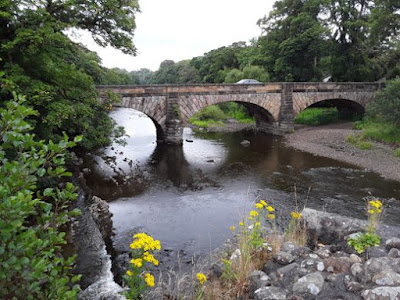
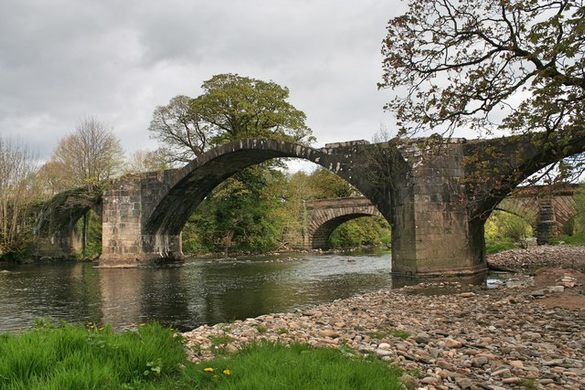
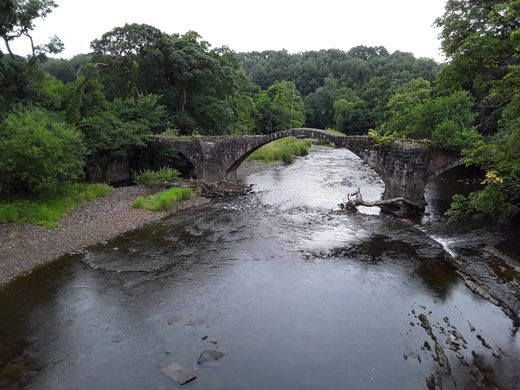
Oliver Cromwell marched his army over this narrow bridge to victory at the Battle of Preston in 1648. 

This bridge was built during the Tudor period but found fame in August 1648 in the English Civil War. During the war, Oliver Cromwell marched his army of more than 8,000 soldiers along with artillery over the bridge on his way to the battle of Preston. Despite being outnumbered, he defeated the combined army of English Royalists and  Scots “Engagers” who marched south in support of King Charles I.


The bridge was a packhorse bridge and has been out of use since the nearby Lower Hodder Bridge was built in the early 19th-century. The parapets of Cromwell’s Bridge were constructed very low from the start, to allow pack horses, loaded with panniers, to cross.

The bridge provides an attractive and romantic setting. The central arch has become quite popular with wedding photographers.

Clancy's comment: I loved seeing these ancient structures when I toured the UK and Europe.

I'm ...


7 January 2022 - MARGATE CAVES - ENGLAND


MARGATE CAVES 

- ENGLAND -


G'day folks,

This forgotten chalk mine was reopened thanks to a massive effort from the local community.  

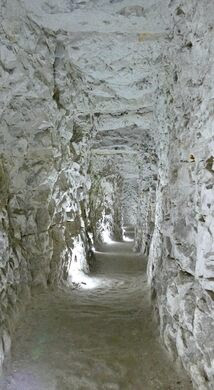
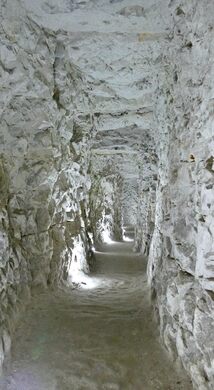
The Margate Caves is a subterranean wonderland located underneath an unassuming street in Margate. The caves are actually a forgotten chalk mine that was rediscovered during the 18th-century. 

The caves first opened to the public during the Victorian era as a “Smugglers Cave,” and were important to Margate’s burgeoning tourism industry. The caves changed ownership several times until they were eventually closed in 2005 due to instability. In 2011, the owner of the cave destroyed the entrance. 


Not long after the entrance was closed, members of the community formed the organization, Friends of Margate Caves. The group, along with The Margate Caves Community Education Trust, worked together to raise funds to save the caves. They were eventually reopened to the public. 

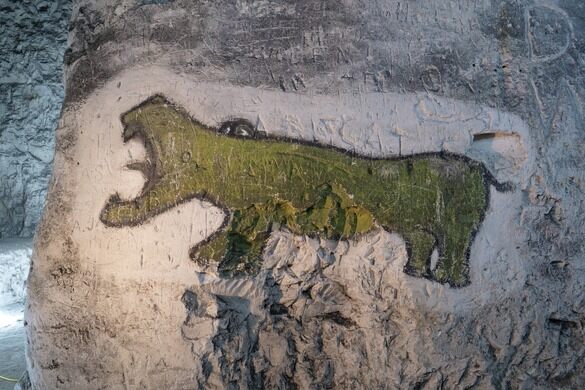
In 2019, the caves finally reopened to the public. Inside, visitors can explore around 200 years of history and marvel at the bizarre menagerie of paintings. The artwork dates between the early 1800s, to the most modern being painted around the 1980s. 

Clancy's comment: This would be worth visiting.

I'm ...


21 June 2021 - THE SEVEN SISTERS, ENGLAND


THE SEVEN SISTERS, ENGLAND


G'day folks,

We all want a break and get away from the constant bad news. What could help is to be is a place where we can just get some "me-time", where we would be surrounded by some pleasant sights and can just calm down and not think about anything. This might be a good spot. 


Located on the coast of England's East Sussex between Seaford and Eastbourne, the Seven Sisters – named so because of the seven hilltops that encompass the silhouette of the cliffs – are one of England's great natural wonders. These majestically beautiful chalk cliffs are so serene to look at and are easily one of the most peaceful places you can imagine yourself to be in. Apart from being so incredibly gorgeous, the stark white cliffs have a distinct purity about them that you are unlikely to find in many places. 

The rolling paths along all the seven cliffs end at a wonderful café, where you can treat yourself to some nice goodies while admiring the breathtaking landscape.

 
Clancy's comment: I've been to this area, and found it amazing on wild, windy days.

I'm ....


31 March 2020 - Bramhope Tunnel North Portal - England


Bramhope Tunnel North Portal 
- England -

G'day folks,

This Gothic castle-like portal is a testament to the amazing craftsmanship of the navvies who built the railway tunnel. 


The Bramhope Tunnel was built for the Leeds to Thirsk railway line at the height of England’s railroad mania in the 1840s. Around the village today, you can see four of the 20 original airshafts intact, a tall sighting tower and plenty of large earth piles that look almost like small hills along the length of the tunnel. If you follow them far enough, they will lead you to this incredible castle-like facade.


At the north entrance of the Bramhope Tunnel, a Gothic-style castellated portal was built from sandstone rock. It has three side towers with turrets, and a horseshoe-shaped archway decorated with a carving of a bearded man (possibly the likeness of the landowner for whom the facade was built). The portal is sadly somewhat in disrepair now, and often has graffiti emblazoned on it.


The tunnel and the visible castle facade were constructed between 1845 to 1849 by hundreds of navvies—railway workers—who came from all over the United Kingdom and lived with their families in the area. Aside from the north portal, the tunnel is known for its impressive length, stretching just over 2 miles long. 


 In the end, when it was built, the entire railway line from Leeds to Thirsk cost over £2 million. It sadly also cost lives. At the time, roughly 23 workers were thought to have lost their lives building the tunnel; however, records of many others have been uncovered since. A replica of the north portal was erected as a memorial to the workers in the churchyard of Otley parish nearby.


Clancy's comment: In all my travels around the world, I've always appreciated the workmanship of  structures like this. And, as opposed to many modern structures, they will be standing for many years to come.


I'm ...


25 February 2020 - THE CAVES OF NOTTINGHAM


THE CAVES 
OF 
NOTTINGHAM

G'day folks,

A labyrinthine underworld of tunnels and caverns hides beneath this city.


 Underneath the modern city of Nottingham is a large and ancient labyrinthine underworld. Over 550 caves, tunnels, and passages cut into the sandstone rock lurk beneath the city, and more are discovered every year.


The oldest recorded name for Nottingham is “Tigguo Cobauc,” which, in the pre-Roman ancient British language is thought to mean “Place of Caves.” The name is still appropriate today, as there are more caves underneath the city than any other in Britain. Nottingham sits on a ridge of soft sandstone hills, which in places have been cut into low cliff faces by the action of the River Leen and River Trent. The exposed soft crumbly rock is incredibly easy to cut and burrow into.


The caves were dug for many reasons: as workplaces, such as the medieval tannery that exists underneath a shopping mall; as homes, such as those at Sneinton hermitage; as secret passages and tunnels, such as those at Castle Rock; as storerooms, brewhouses, and public houses; as prisons and dungeons; and in more recent history, as air raid shelters during the Nottingham Blitz. Scattered across the city are small doors and gates, complete with rusty padlocks that cover access points into the greatly interconnected labyrinth.


The Nottingham Caves Survey, a project by researchers at Nottingham University to digitally map the caves, has seen many local homeowners come forward to reveal that they too have caves leading off into the subterranean maze from their basements or tucked away in the corner of their garden. Some have been surprised to learn that their particular cave was previously unknown. As recently as January 2017, a group of students living on one of the main roads into the city, Mansfield Road, discovered a series of steps leading down from their cellar into a previously unknown void under the city streets.


One of the most well-known and well-connected cave systems is the Broadmarsh Caves, which is open to visitors under the name “City of Caves.” This visitor attraction can be accessed from a dilapidated shopping mall, the Broadmarsh Centre, which is scheduled for demolition and redevelopment. In it, underneath the 1970s brutalist edifice, visitors can take a guided tour around the medieval tannery cut out of the sandstone, the remains of a medieval slum, and one of the city’s sandstone air-raid shelters.

Another system called Mortimer’s Hole is also open to the public, accessed from Brewhouse Yard. This cave is named after Sir Roger Mortimer, the lover of Queen Isabella of England in 1330. The enraged king is said to have entered the grounds of Nottingham Castle by stealth through this secret tunnel, from the base of the Castle Rock cliff, and seized poor Mortimer as he lay in bed with the queen. He was taken from Nottingham to London to be hung, drawn, and quartered. (Tales of his ghost still haunting the hole, which bears his name, remain unverified.)


Other great places to visit the caves include the Trip to Jerusalem public house, reputed to be Englands oldest pub, the Lost Caves cocktail bar, and the Hand and Heart, all of which have cave rooms for drinking and eating in, and the Bell Inn. If you inquire in advance, the Bell can arrange tours of its caves underneath the Old Market Square, including one that contains a well once used by local monks for brewing ale. Live action puzzle fans are accommodated in one of the city’s latest labyrinths to be made publicly accessible; the “Cave Escape” escape rooms can be found in gloomy subterranean chambers and tunnels beneath Mansfield Road.


Clancy's comment: Wow. More are found each year?

I'm ...