Showing posts with label BLACKS. Show all posts

10 January 2023 - BLACK GRAVEYARD HIDDEN IN NEW YORK CAR PARK


 BLACK GRAVEYARD 

HIDDEN IN 

NEW YORK CAR PARK


G'day folks,

An historic Black graveyard is hidden in the parking lot of one of America's largest malls.  

The hulking Palisades Mall is among the largest “mega malls” in the United States. The vast concrete complex opened in 1998, swiftly becoming known as one of the ugliest malls in the country. Described by the New York Times as a, “series of interlocking coffins…lacking any discernible architectural theme,” the mall would be grim enough itself, were it not for the fact that there’s a small, historic cemetery lying largely unnoticed in the parking lot.

Around 20 million shoppers descend on the Palisades Mall every year, most of whom probably have no idea they’re passing by Mount Moor Cemetery, a Black graveyard listed on the National Register for Historic Places that lies dwarfed in the shadow of the Target parking lot and a Dick’s Sporting Goods.
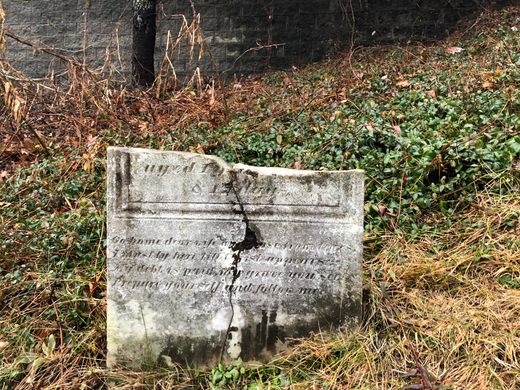


Mount Moor was deeded in July, 1849, as a “burying ground for colored people.” The sloping hill is the final resting place for around 90 Black Americans, including veterans of the Civil War, the Spanish-American War, the two World Wars and the Korean War. 

The rise of the mega mall saw many family-run stores that been had been around for generations lost for good. The landscape and social history of many small towns were paved over to make way for these concrete cathedrals to consumer capitalism. And Mount Moor,, bounded by the New York State Thruway and Routes 59 and 303, soon fell under the greedy eyes of property developers. 


When Syracuse-based Pyramid Companies announced its intention to build one of the largest malls in America, it found the small, historic cemetery right in the middle of their plans. Offers to have the graves disinterred and relocated to another cemetery were swiftly met with short shrift. A reported offer of $100,000 to sell the cemetery was rejected by the Mount Moor Cemetery Association, who work doggedly to preserve and take care of the historic site. 

The property developers were forced to build their colossus around the tiny cemetery, which today can still be found on the sloping ground overlooking the car park. It is cared for diligently by members of the association and the descendants of those buried there. 

One particular grave belongs to Lafayette Logan, who fought in the Civil War with the Massachusetts 54th Regiment, the first Black regiment mustered by the North. Immortalized in the 1989 Academy award winning film Glory, he perhaps deserves more a dignified final resting place than in the shadow of a giant Bed Bath & Beyond. 


27 September 201 - GEORGE STINNEY - 14 YEAR-OLD BOY EXECUTED


GEORGE STINNEY 

- 14 YEAR-OLD BOY EXECUTED  -


G'day folks,

On March 23, 1944, in South Carolina, two white girls, 11-year-old Betty June Binnicker and 7-year-old Mary Emma Thames, were found dead. They had failed to return home the night before.

Police arrested George Stinney, then 14, and his older brother Johnny, for the murders. Johnny was released but George was held and charged for the murders. His trial, by an all-white jury, lasted one day, and he was found guilty. 


He had not been allowed to see his family before the trial and he was questioned alone without an attorney. During the trial Stinney's defense offered no cross-examination, did not call witnesses and offered virtually no defense. The jury deliberated for ten minutes before he was found guilty and sentenced to death.

Stinney was executed shortly after, on June 16, 1944. He was so small compared to adult prisoners that prison staff had difficulty securing him to the electrodes. Only 83 days had passed between his arrest and his death, and he became the youngest American to be sentenced to death and executed.

In 2004 the case was re-opened, and in 2014 the conviction against Stinney was vacated as it was determined by the court that he had not received a fair trial.

Clancy's comment: Justice should not only be done, but also be seen to be done. Amen!

I'm ...


2 August 2018 - DR. GARY FOLEY - ACTIVIST AND ACADEMIC


 DR. GARY FOLEY
 - ACTIVIST AND ACADEMIC -

G'day folks,

Welcome to some background notes on a man who became one of Australia's most infamous activists.


 Gary Foley spent most of his youth in Nambucca Heads. Expelled from school at the age of 15, Foley came to Sydney as a 17-year-old apprentice draughtsperson. Since then he has been at the centre of major political activities including the 1971 Springbok tour demonstrations, the Tent Embassy in Canberra in 1972, the Commonwealth Games protest in 1982, and more recently, the protests during the 1988 bicentennial celebrations.


He was also involved in the formation of Redfern's Aboriginal Legal Service (in Sydney) and the Aboriginal Medical Service in Melbourne. In 1974 Foley was part of an Aboriginal delegation that toured China and in 1978 he was with a group that took films on black Australia to the Cannes Film festival and then to Germany and other European countries.

He returned to England and Europe a year later and set up the first Aboriginal Information Centre in London. Foley has been a director of the Aboriginal Health Service (1981) and the Director of the Aboriginal Arts Board (1983-86) and the Aboriginal Medical Service Redfern (1988). He has been a senior lecturer at Swinburne College in Melbourne, consultant to the Royal Commission into Black Deaths in Custody (1988) and a board member of the Aboriginal Legal Service. He has also served on the national executive of the National Coalition of Aboriginal Organisations.

His acting career began in 1972 with the revue Basically Black. Since then he has appeared in Backroads (1976) , Going Down (1983), Buckeye & Pinto (1979, Pandemonium (1988), Dogs in Space (1978). He also appeared in TV series Flying Doctors (1990) and 5 episodes of A Country Practice. (1989). More recently he has featured in documentary films such as "Fair Play" (2010) (episode 4 of Have you Heard From Johannesburg Stories From the Global Anti-Apartheid Movement 1948-1990), The Redfern Story 2014, Persons of Interest (2013) TV series on ASIO, the film The Foundation (2013)

Late in life Foley became a student at University of Melbourne where he studied history, cultural studies and computer science. He completed his BA with majors in History and Cultural Studies in 2000, and gained first class Honours in History at at the end of 2002. 

Between 2001 and April 2005 he was also the Senior Curator for Southeastern Australia at Museum Victoria. Between 2005 and 2008 he was a lecturer / tutor in the Education Faculty of University of Melbourne, and in 2008 took up a position as Senior Lecturer in History and Politics at Moondani Balluk centre at Victoria University in western Melbourne.

In 2013 he completed a PhD in History at the University of Melbourne, for which he was in 2014 awarded the University of Melbourne's prestigious Chancellor's Award for Excellence.


Clancy's comment: Go, Gary! I met this man on two occasions when we were marching though the streets of Melbourne with thousands of others. One thing I admired about Gary was his willingness to stand up and shout about the big issues, and he has achieved much for a boy who was expelled from school at 15. 
Love ya work, Gary!

I'm ...


1 July 2018 - JACKIE ROBINSON COURT MARTIALED FOR SITTING NEXT TO A BLACK WOMAN


JACKIE ROBINSON COURT MARTIALED  FOR SITTING 
NEXT TO A BLACK WOMAN


G'day folks,

Jack Roosevelt Robinson was an American professional baseball second baseman who became the first African American to play in Major League Baseball in the modern era, but Jackie Robinson had a Rosa Parks moment of his own long before he broke the race barrier in baseball


Three years before he became the first black man to play in major league baseball, and more than a decade before Rosa Parks refused to give up her bus seat, Jackie Robinson had a Rosa Parks moment of his own. Lieutenant Robinson, as he was known in 1944, was serving in the U.S. Army at one of the worst posts for black men — Camp Hood. Located outside of Waco, Texas, the area’s residents were infamously hostile to servicemen of colour.

On the evening of July 6, Lieutenant Robinson boarded a Southwestern Bus Company bus and took a seat next to a fellow officer’s fair-skinned wife, who was in fact African American. The driver believed the woman was white and, this being 1944, told Robinson to get to the back. Robinson, whose military career had been exemplary up that point, refused to move and told the driver to focus on his driving instead.


His response didn’t go over well. The men argued all the way to Robinson’s stop, where the bus dispatcher got involved, calling Robinson… well, you can probably guess what he called him. An angry crowd of racist civilians and military police officers formed around the bus. 


A woman threatened to press charges against the future number 42. The prevalence of lynching in Texas must have been on his mind, but Robinson showed no signs of fear. One of the military policemen urged him to head to the police station with him, so they could sort the matter out in a relatively saner setting. Robinson agreed, but when they got there, another white officer ran up to the car and asked if they had “the nigger lieutenant.” Robinson told the men that he would “break in two” the next person to use that word.


Thirteen depositions were taken alleging that Robinson had behaved badly and he was court-martialed over the matter. Fearing that he wouldn’t get a fair trial, he wrote to the secretary of war’s civilian aide, asking for advice. “I don’t want any unfavorable publicity for myself or the army,” he wrote, “but I believe in fair play.” By some stroke of luck, Robinson was acquitted of all charges.


Clancy's comment: Go, Jackie! Love ya work! I admire those who stand up for the issues they shouldn't have to stand up for, but by so doing, they change the world for the better.

I'm ...